Lesson 2 of 6
Functions, domains and outputs
You used an equation to connect distance and a bill. Now ask what makes that rule usable for every permitted request.
One permitted input, one defined output
A vending machine accepts a selection and follows a rule. A mathematical function does the same: each permitted input has exactly one output. Different inputs may share an output.
For f(x) = 2x + 1, what comes out when x is 3? Would one input producing two different outputs still define a function?
Need a quick refresher?
An expression calculates a value. An equation compares values. The chosen domain is part of the function's definition.
Review Variables and equations →A function is a promise: one input, one output
1 · Observe
Autos, fares and a surprise
| Word | What it means |
|---|---|
| Function | A rule that gives exactly one output for each input. |
| Domain | The inputs the rule is allowed to take. |
| Input and output | What goes in, and what comes out. |
| Undefined | No answer exists, as with dividing by zero. |
| Square root | The non-negative number that squares to the input. |
An auto-rickshaw fare is ₹30 plus ₹14 per kilometre. Give the driver a distance and he gives you exactly one fare. That reliability is what mathematicians call a function. If the same distance could produce two different fares, you could not plan a budget.
2 · Express
Function notation
We write f(x) for the output of the rule f at input x. The set of allowed inputs is the domain. The set of outputs actually produced is the range.
3 · Visualize
Evaluating, and guarding the domain
| km | fare (₹) |
|---|---|
| 0 | 30 |
| 2.5 | 65 |
| 10 | 170 |
Asking for a fare at −1 km is outside the domain. Code should say so loudly instead of returning a number. The same idea shows up in 1 ÷ (x − 3): any x works except 3, where the denominator is zero. Near 3 the output explodes, at x = 3.001 it is 1,000, and at 3 it does not exist.
- left of 3
- right of 3
See the numbers behind this picture
| x | left of 3 | right of 3 |
|---|---|---|
| 0 | -0.333 | – |
| 0.1 | -0.345 | – |
| 0.2 | -0.357 | – |
| 0.3 | -0.37 | – |
| 0.4 | -0.385 | – |
| 0.5 | -0.4 | – |
| 0.6 | -0.417 | – |
| 0.7 | -0.435 | – |
| 0.8 | -0.455 | – |
| 0.9 | -0.476 | – |
| 1 | -0.5 | – |
| 1.1 | -0.526 | – |
| 1.2 | -0.556 | – |
| 1.3 | -0.588 | – |
| 1.4 | -0.625 | – |
| 1.5 | -0.667 | – |
| 1.6 | -0.714 | – |
| 1.7 | -0.769 | – |
| 1.8 | -0.833 | – |
| 1.9 | -0.909 | – |
| 2 | -1 | – |
| 2.1 | -1.111 | – |
| 2.2 | -1.25 | – |
| 2.3 | -1.429 | – |
| 2.4 | -1.667 | – |
| 2.5 | -2 | – |
| 2.6 | -2.5 | – |
| 2.7 | -3.333 | – |
| 2.8 | -5 | – |
| 2.9 | -10 | – |
| 3.1 | – | 10 |
| 3.2 | – | 5 |
| 3.3 | – | 3.333 |
| 3.4 | – | 2.5 |
| 3.5 | – | 2 |
| 3.6 | – | 1.667 |
| 3.7 | – | 1.429 |
| 3.8 | – | 1.25 |
| 3.9 | – | 1.111 |
| 4 | – | 1 |
4 · Discover
Not every rule is a function
The question 'what number squares to 4?' has two answers, +2 and −2. One input, two outputs: not a function. The square-root function fixes this by promising the non-negative answer, so √4 = 2 every time.
5 · Apply
Two worked examples
Example 1, a fare. fare(2.5) = 30 + 14 × 2.5 = 65. The same input always gives 65.
Example 2, a domain. g(x) = √(x − 1). For x = 5, g = 2. For x = −3 the square root of −4 is not a real number, so the domain is x ≥ 1.
6 · Where it goes wrong
Three ways it goes wrong
7 · In Python
A fare function with guards
Here is how to implement it, step by step. The code below does exactly these steps, and every line is editable.
- Write the rule as a function with a name, such as fare(km).
- State the domain: for fare, km must be zero or more.
- Make the code refuse inputs outside the domain, loudly.
- For a division, find the input that makes the denominator zero and exclude it.
- Test the edges: just inside and just outside the domain.
import math

def fare(km):
    """Auto fare: rupees. Defined only for a distance of zero or more."""
    if km < 0:
        raise ValueError("distance cannot be negative")
    return 30 + 14 * km

for km in (0, 2.5, 10):
    print("fare(", km, ") =", fare(km))

try:
    fare(-1)
except ValueError as e:
    print("fare(-1) ->", e)

# a rule that is not a function of x alone: one input, two outputs
pairs = [(4, 2), (4, -2)]            # x = 4 gives both +2 and -2 as 'square roots'
print("inputs repeated with different outputs:", {x for x, _ in pairs if sum(1 for a, _ in pairs if a == x) > 1})
print("the function sqrt picks one:", math.sqrt(4))

# the domain of 1 / (x - 3): everything except 3
for x in (2, 3.001, 4):
    print("1 / (x - 3) at", x, "=", round(1 / (x - 3), 3))
try:
    1 / (3 - 3)
except ZeroDivisionError:
    print("1 / (3 - 3) -> undefined, 3 is outside the domain")
fare( 0 ) = 30
fare( 2.5 ) = 65.0
fare( 10 ) = 170
fare(-1) -> distance cannot be negative
inputs repeated with different outputs: {4}
the function sqrt picks one: 2.0
1 / (x - 3) at 2 = -1.0
1 / (x - 3) at 3.001 = 1000.0
1 / (x - 3) at 4 = 1.0
1 / (3 - 3) -> undefined, 3 is outside the domainEdit and run this code in your browser
Live Python
Evaluate, guard the domain, spot a non-function
Runs in your browser on your device. Nothing you type is sent anywhere, and nothing here changes your saved progress.
Press Ctrl+Enter (⌘+Enter on Mac) to run. Tab moves focus to the next control, as usual; use spaces to indent.
Predict, then explore
Before changing anything: Compare mappings (1,4),(2,4) and (2,4),(2,7). Which breaks the promise? Predict before changing the lookup mapping.
Use the Lookup mapping selector to compare shared outputs with conflicting outputs. Separately change the input and Function rule; read the resulting f(x) and the matching table row.
Playground
Feed the fare machine
A delivery app quotes f(d) = 2d + 3 rupees for d km. One input in, exactly one quote out, but only for distances the app serves (0 to 30 km). Try a negative distance.
- Input d
- 2.5 km
- Output f(d)
- ₹8
- In the domain?
- yes
The domain is the set of inputs the rule accepts. Outside it, the machine does not return a wrong number: it returns no quote at all.
The general function explorer
Function Explorer
f(x) = 2x + 3. At x = 2, output = 7.
Mapping: (1, 4), (2, 4). This is a function: each input has one output. Domain: 1, 2. Range: 4.
See the exact values behind the graph
| Input x | Selected output |
|---|---|
| -4 | -5 |
| -3 | -3 |
| -2 | -1 |
| -1 | 1 |
| 0 | 3 |
| 0.5 | 4 |
| 1 | 5 |
| 2 | 7 |
| 3 | 9 |
| 4 | 11 |
In your own words: what changed, and why did the output change with it?
Now you drive
Write a function with a domain
A Python def is a function in exactly the maths sense: one input in, one output out. The domain becomes a guard that refuses inputs the rule does not accept.
| Maths | Python | In plain words |
|---|---|---|
| f(d) = 2d + 3 | return 2 * d + 3 | The rule. |
| domain: 0 ≤ d ≤ 30 | if d < 0 or d > 30: raise ValueError | Refuse anything outside it. |
Live Python
fare(d) with a guarded domain
Runs in your browser on your device. Nothing you type is sent anywhere, and nothing here changes your saved progress.
Press Ctrl+Enter (⌘+Enter on Mac) to run. Tab moves focus to the next control, as usual; use spaces to indent.
Stuck? Show a worked solution (try first!)
def fare(d):
    """Delivery fare in ₹ for d km. The app serves 0 to 30 km only."""
    if d < 0 or d > 30:
        raise ValueError("outside the domain")
    return 2 * d + 3

for d in (0, 2.5, 7):
    print(f"{d} km -> ₹{fare(d)}")
try:
    fare(-1)
except ValueError as err:
    print("-1 km ->", err)
Experiment, then explain
Finish the TODOs, then try the quick experiments. Think about each question before opening its answer.
Why raise an error instead of returning 0 for a bad distance?
A 0 looks like a real quote. An error cannot be mistaken for an answer, which is how a function stays honest about what it does not cover.
These are the same fares as the playground: 2.5 km costs ₹8 and 0 km costs the ₹3 fee.
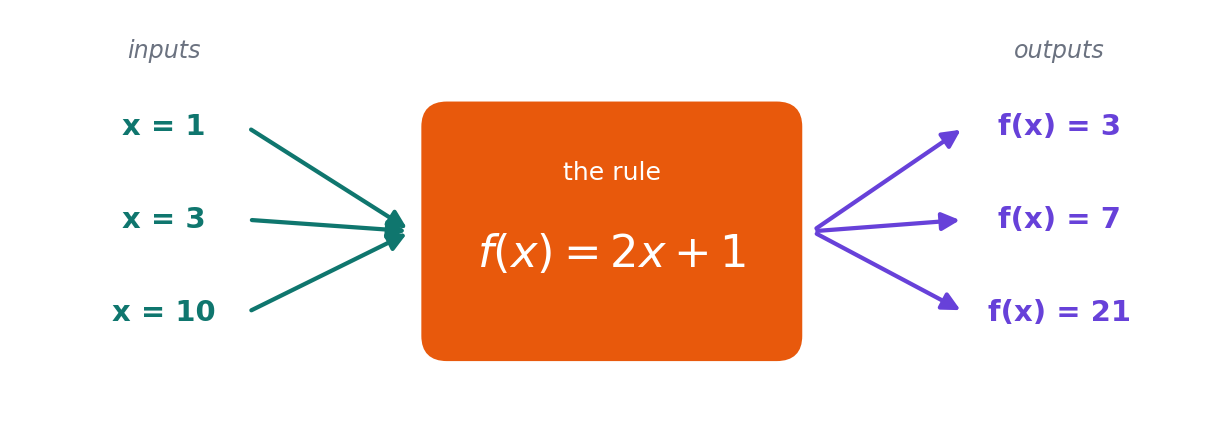
| Input x | Rule | Output f(x) |
|---|---|---|
| 1 | 2 × 1 + 1 | 3 |
| 3 | 2 × 3 + 1 | 7 |
| 5 | 2 × 5 + 1 | 11 |
Writing f(x) names the result of applying f to x; it does not mean f multiplied by x. The domain tells us which inputs the rule permits. 1/(x−2) excludes 2; a 40-seat bus also imposes whole-number passenger counts from 0 to 40.
Relate the playground’s rule to this reading
A function assigns exactly one output to each input in its domain. The domain is the set of allowed inputs; the range is the outputs those inputs produce. Different inputs may share an output.
For f(x) = 2x + 3 and domain {0,1,2}, the range is {3,5,7}. f(2) means apply the rule at input 2, giving 7. The function name is not another multiplier.
A domain can come from the problem or arithmetic. A ticket count may need to be a nonnegative integer; 1/x excludes zero because division by zero is undefined. A calculator's willingness to accept a number does not make it meaningful in context.
Use f for the rule and f(x) for its output. Domain and range belong to the stated function, not just the formula printed on screen.
Symbol and unit reference
f, f(x)- Function name and its output at x
domain- Permitted input set
range- Outputs produced by the permitted inputs
f(g(x))- Apply g, then f
Another worked example
For f(x) = 2x + 3, f(2) = 7. Pairs (1,4) and (2,4) are a function: both inputs have one output. Pairs (2,4) and (2,7) are not: the same input has conflicting outputs.
Connect the relationship to Python
def delivery_bill(distance_km):
    return 2 * distance_km + 3

quote = delivery_bill(2)  # 7
def names a reusable rule, the argument supplies an input, and return supplies its output. This short arithmetic example omits production input validation; the allowed domain must still be specified.
Why this matters for ML
A preprocessing function must produce a well-defined output for each supported record. An out-of-domain record needs an explanation, not a made-up number.
Try a different situation
A lookup maps product A to 10 rupees and product B to 10 rupees. Is that a function? What if product A also maps to 12 rupees under the same rule?
Compare your reasoning
Shared prices are allowed: each product still has one output. Assigning two different prices to the same product under the same stated rule violates the function definition. A time or pricing tier could instead become an additional input if the context requires it.
Not scored or saved. Compare your reasoning, not just the answer.
Read a larger expression when you’re ready
The five-level Equation X-Ray connects these ideas to multiple inputs, curves, nested functions and indexed sums. Choose any level; advanced solving is not required.
Equation X-Ray · Read the structure, then explain it
Mathematics as a language
Start with a familiar rule and build toward a larger expression. Reading its pieces comes before solving advanced equations. You can explore any level.
One rule, many possibilities
A trip has a 3-rupee booking fee and costs 2 rupees per kilometre. How can one statement describe any permitted distance?
y = 2x + 3
Read the relationship before trying to solve it. This is an illustrative example, separate from the live experiment.
Choose a building block to inspect its role.
Read the operations: Multiply distance by its rate, then add the fee. If a bill is known, solving asks which distance makes both sides equal.
Build the expression from smaller operations
Choose a valid construction in the stated order. This exercise organizes dependencies; it does not claim every implementation must evaluate independent branches in this order.
What problem could this relationship represent?
A booking fee plus a distance charge is one possible interpretation; a fixed production setup cost plus a per-item charge has the same structure.
Context we still need: Symbols alone do not establish currency, physical meaning or whether negative distances are allowed.
Connect the operations to code
bill = 2 * distance_km + 3Read the code as a map of operations. It is not executed here; imports, shapes and numerical safeguards depend on the actual lesson.
Explain a changed situation
Your notes and reveals are temporary. This reading practice does not change lesson completion or saved assessment evidence.
Understanding checks
Use the worked reasoning above. Answers within 0.001 count as correct.
Carry this idea forward
A useful function needs an input contract as well as a calculation.
Next, put the input-output pairs on axes so the relationship becomes visible.
What the existing checks cover
- Identify a valid function without confusing repeated outputs with conflicting outputs.
- Interpret function notation and calculate an output.
- Identify input restrictions before evaluating a rule.
- Find the outputs produced by a stated domain.
Build your lesson evidence
Try the experiment. 0 of 4 checks done.