Lesson 1 of 6
Variables and equations
Start here: a variable gives us a short name for a quantity; an equation keeps the relationship while the numbers change.
An equation turns a bill into a question
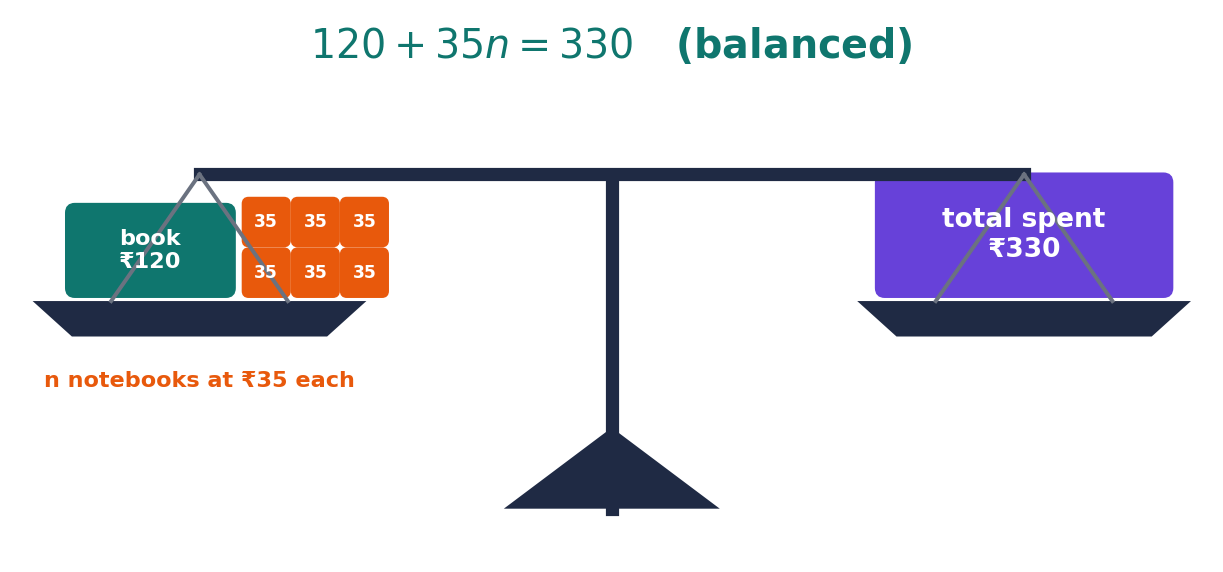
A book costs ₹120 and each notebook costs ₹35. Your bill is ₹330. Instead of guessing notebook counts, give the unknown a name: n. The equation records the story; solving it finds a value that makes the story true.
Would six notebooks fit the bill? What must stay equal when you subtract the book price?
Need a quick refresher?
Multiplication happens before addition. The equals sign compares values; it is not an instruction to keep calculating.
A bill you can write down, and run backwards
1 · Observe
A delivery app and an unexplained bill
| Word | What it means |
|---|---|
| Equation | Two things joined by an equals sign, claiming they have the same value. |
| Unknown | The number you are trying to find, usually called x. |
| Parameter | A number in the rule that is fixed for now, such as the ₹40 starting fee. |
| Inverse (undo) | Reversing a rule's steps, in the opposite order. |
| Substitute | Putting a number in place of x to check it. |
A delivery app charges ₹40 to start and ₹12 for every kilometre. Rahul sees a bill of ₹160 and wonders how far the rider went. He could guess and check, but there is a faster way: write the rule as an equation and run it backwards.
This is the oldest trick in mathematics, and the first one machine learning uses. A model is a rule with some numbers in it. Learning is finding the numbers that make the rule match the world.
2 · Express
Naming the unknown
Let x be the distance in kilometres. The bill is the fixed fee plus the rate times x. The ₹40 and the ₹12 are parameters: numbers we set and hold still while x varies. The 12 multiplying x is a coefficient.
3 · Visualize
Undo in reverse order
The bill was built by multiplying x by 12, then adding 40. To undo, reverse the order: subtract 40 first, then divide by 12. Whatever you do to one side, do to the other, so the equality stays true.
| Step | Left side | Right side |
|---|---|---|
| Start | 40 + 12x | 160 |
| Subtract 40 from both sides | 12x | 120 |
| Divide both sides by 12 | x | 10 |
Check by substituting: 40 + 12 × 10 = 160. The rider went 10 km. For bills of ₹100, ₹160, ₹220 and ₹52 the distances are 5, 10, 15 and 1 km.
See the numbers behind this picture
| Distance (km) | bill = 40 + 12x |
|---|---|
| 0 | 40 |
| 0.5 | 46 |
| 1 | 52 |
| 1.5 | 58 |
| 2 | 64 |
| 2.5 | 70 |
| 3 | 76 |
| 3.5 | 82 |
| 4 | 88 |
| 4.5 | 94 |
| 5 | 100 |
| 5.5 | 106 |
| 6 | 112 |
| 6.5 | 118 |
| 7 | 124 |
| 7.5 | 130 |
| 8 | 136 |
| 8.5 | 142 |
| 9 | 148 |
| 9.5 | 154 |
| 10 | 160 |
4 · Discover
The same equation, different parameters
If the app raises its fee to ₹60, the same ₹160 buys fewer kilometres: (160 − 60) ÷ 12 = 8.33 km. The unknown is still x. The parameters changed. Keeping the roles straight, what is held fixed and what is being found, is half of reading any model.
5 · Apply
Two worked examples
Example 1, the unit check. ₹12 per km × 10 km = ₹120, and ₹120 + ₹40 = ₹160. Rupees per kilometre times kilometres gives rupees, which can be added to a fee in rupees. If the units do not line up, the equation is wrong.
Example 2, the degenerate case. Suppose the app charged 0 per km: 0 × x + 40 = 160. No x can make that true. With a rate of 0, the bill does not depend on distance, and you cannot recover distance from it.
6 · Where it goes wrong
Three ways it goes wrong
7 · In Python
The bill rule in code
Here is how to implement it, step by step. The code below does exactly these steps, and every line is editable.
- Write the rule: bill = 40 + 12 × km.
- Write what you know: bill = 160.
- Undo the last step first: subtract 40 from both sides, giving 12 × km = 120.
- Undo the next step: divide both sides by 12, giving km = 10.
- Check by substituting: 40 + 12 × 10 = 160.
import numpy as np

fee, per_km = 40, 12                        # rupees: fixed fee, rupees per kilometre
bill = lambda km: fee + per_km * km
print("bill for 0, 5, 10 km:", [bill(k) for k in (0, 5, 10)])

# equation: 40 + 12 x = 160  ->  undo the addition, then undo the multiplication
target = 160
x = (target - fee) / per_km
print("distance that gives a bill of", target, "=", x, "km | check:", bill(x))

# the same unknown for several bills at once
bills = np.array([100, 160, 220, 52])
print("distances:", (bills - fee) / per_km)

# parameters change between experiments, x stays the unknown
for new_fee in (40, 60):
    print("fee", new_fee, "-> a 160 rupee bill covers", round((160 - new_fee) / per_km, 2), "km")
bill for 0, 5, 10 km: [40, 100, 160]
distance that gives a bill of 160 = 10.0 km | check: 160.0
distances: [ 5. 10. 15. 1.]
fee 40 -> a 160 rupee bill covers 10.0 km
fee 60 -> a 160 rupee bill covers 8.33 kmEdit and run this code in your browser
Live Python
Write the rule, run it backwards
Runs in your browser on your device. Nothing you type is sent anywhere, and nothing here changes your saved progress.
Press Ctrl+Enter (⌘+Enter on Mac) to run. Tab moves focus to the next control, as usual; use spaces to indent.
Predict, then explore
Before changing anything: A 2 km trip costs 7 rupees. If only the distance doubles, does the whole bill double? Explain which part changes before moving the distance control.
Keep coefficient a = 2 and fixed fee b = 3. Change input x from 2 to 4; compare the calculated output and table. The separate target equation asks which distance produces a bill of 11.
Try a quick prediction
1 · Start with a question
The trip gets longer. What happens to the bill?
Keep the 2-rupee/km rate and 3-rupee fee fixed. Change distance from 2 km to 4 km. The bill starts at 7 rupees; what happens next?
Not scored and not saved.
Playground
Find the number that balances the bill
A book costs ₹120 and each notebook ₹35. The bill is ₹330. Instead of guessing, call the number of notebooks n: the story becomes 120 + 35n = 330. Slide n until the two sides balance.
- Your side: 120 + 35n
- ₹190
- The bill
- ₹330
- Difference
- −₹140
Solving is just undoing, in reverse order: subtract the book (330 − 120 = 210), then divide by the price (210 ÷ 35 = 6).
The general function explorer
Function Explorer
f(x) = 2x + 3. At x = 2, output = 7.
Target equation: 2x + 3 = 11. Recovered x = 4. The graph includes mathematical inputs that may be outside a real delivery's nonnegative-distance domain.
See the exact values behind the graph
| Input x | Selected output |
|---|---|
| -4 | -5 |
| -3 | -3 |
| -2 | -1 |
| -1 | 1 |
| 0 | 3 |
| 0.5 | 4 |
| 1 | 5 |
| 2 | 7 |
| 3 | 9 |
| 4 | 11 |
In your own words: what changed, and why did the output change with it?
Now you drive
Turn the story into two functions
An equation records a story; Python can both run the story forward (bill) and undo it backward (solve).
| Maths | Python | In plain words |
|---|---|---|
| 120 + 35n | book + price * n | The bill for n notebooks. |
| n = (330 − 120) ÷ 35 | (total - book) / price | Undo the addition, then the multiplication. |
Live Python
bill() and solve()
Runs in your browser on your device. Nothing you type is sent anywhere, and nothing here changes your saved progress.
Press Ctrl+Enter (⌘+Enter on Mac) to run. Tab moves focus to the next control, as usual; use spaces to indent.
Stuck? Show a worked solution (try first!)
book = 120       # ₹ for the book
price = 35       # ₹ per notebook
total = 330      # the bill

def bill(n):
    return book + price * n

def solve(price, book, total):
    return (total - book) / price

n = solve(price, book, total)
print(f"{n} notebooks")
print(f"check: bill({n}) = {bill(n)}  (target {total})")
Experiment, then explain
Finish the TODOs, then try the quick experiments. Think about each question before opening its answer.
Why subtract the book before dividing?
The bill was built by multiplying first and adding second, so we undo it in reverse: remove the added ₹120, then undo the ×35. Dividing first would split the book price too.
Try a bill of ₹400. Is the answer a sensible number of notebooks?
It gives 8, which fits. Try ₹250: you get a fraction of a notebook. The equation is solved, but the story says counts must be whole numbers, so check the answer against the situation.
Both solutions agree with the lesson: 6 notebooks, and 120 + 35 × 6 = 330.
| Story | Mathematical record |
|---|---|
| Book plus notebooks | 120 + 35n = 330 |
| Remove the fixed price | 35n = 210 |
| Divide by the price per notebook | n = 6 |
| Check against the story | 120 + 35 × 6 = 330 |
The equals sign asserts that two expressions have the same value. n is an unknown count; 35 is a rate in rupees per notebook. More complex stories can use several variables or squared terms without changing what equality means.
Relate the playground’s rule to this reading
In y = 2x + 3, x is distance in kilometres. The coefficient 2 has rupees/km units; multiplying gives a distance charge in rupees. The constant 3 is added once. y is the calculated bill, not an observed purchase.
To use a known bill, write 11 = 2x + 3. Subtract 3 from both sides to preserve equality, then divide both sides by 2: x = 4 km. Substitution checks the answer: 2 × 4 + 3 = 11.
Representing a relationship and solving a particular question are different steps. An equation can have one solution, several, or none under its constraints. It also leaves out real-world details unless we explicitly model them.
The explorer writes the same family as f(x) = ax + b. f(x) names the output, a the coefficient and b the fixed fee; f(x) does not mean f multiplied by x.
Symbol and unit reference
x- Variable: distance in kilometres
a- Coefficient, rupees per kilometre
b- Constant fee, rupees
t, =- Target bill and equality
Separate practice example: a different pricing rule
For 3x + 1 = 13: subtract 1 from both sides to get 3x = 12; divide both sides by 3 to get x = 4. Substitute back: 3 × 4 + 1 = 13. If a = 0, 0x + b = t has every input as a solution when b = t, and none otherwise.
Connect the relationship to Python
distance_km = 4
price_per_km = 2
fixed_fee = 3
bill = price_per_km * distance_km + fixed_fee
print(bill)  # 11 rupees
The names preserve units and roles. * multiplies the rate and distance; + adds the fee. Python = assigns a value; mathematical = asserts equality.
Why this matters for ML
A prediction model also uses adjustable coefficients. Solving this tiny equation helps explain a prediction without assuming a trained model is correct.
Try a different situation
A bike rental costs 4 rupees per hour plus a 5-rupee fee. Without listing every possible rental, explain how to represent its cost and what one extra hour changes.
Compare your reasoning
Let h be hours and C the cost: C = 4h + 5. One extra hour adds 4 rupees; the 5-rupee fee stays fixed. At 2 hours C = 13 and at 3 hours C = 17.
Not scored or saved. Compare your reasoning, not just the answer.
Read a larger expression when you’re ready
The five-level Equation X-Ray connects these ideas to multiple inputs, curves, nested functions and indexed sums. Choose any level; advanced solving is not required.
Equation X-Ray · Read the structure, then explain it
Mathematics as a language
Start with a familiar rule and build toward a larger expression. Reading its pieces comes before solving advanced equations. You can explore any level.
One rule, many possibilities
A trip has a 3-rupee booking fee and costs 2 rupees per kilometre. How can one statement describe any permitted distance?
y = 2x + 3
Read the relationship before trying to solve it. This is an illustrative example, separate from the live experiment.
Choose a building block to inspect its role.
Read the operations: Multiply distance by its rate, then add the fee. If a bill is known, solving asks which distance makes both sides equal.
Build the expression from smaller operations
Choose a valid construction in the stated order. This exercise organizes dependencies; it does not claim every implementation must evaluate independent branches in this order.
What problem could this relationship represent?
A booking fee plus a distance charge is one possible interpretation; a fixed production setup cost plus a per-item charge has the same structure.
Context we still need: Symbols alone do not establish currency, physical meaning or whether negative distances are allowed.
Connect the operations to code
bill = 2 * distance_km + 3Read the code as a map of operations. It is not executed here; imports, shapes and numerical safeguards depend on the actual lesson.
Explain a changed situation
Your notes and reveals are temporary. This reading practice does not change lesson completion or saved assessment evidence.
Understanding checks
Use the worked reasoning above. Answers within 0.001 count as correct.
Carry this idea forward
An equation compresses a relationship; solving selects values that satisfy a question and its constraints.
Next, ask which inputs a rule accepts and whether each gets one well-defined output.
What the existing checks cover
- Distinguish a variable, coefficient and constant in a practical rule.
- Evaluate an expression with correct operation order and units.
- Solve and verify a simple linear equation.
- Explain why an equation operation must preserve equality.
Build your lesson evidence
Try the experiment. 0 of 4 checks done.